 Base bridge
Base bridge choices determine the destination asset and your options after submission
Base bridge transfers require a route matching your source balance, destination token, and intended recipient before you commit funds. Compare the amount delivered, separate transaction costs, timing conditions, and available recovery actions. An unsigned transfer request leaves room to change those choices. A confirmed token approval creates spending permission without necessarily starting the transfer; a confirmed bridge submission crosses a different boundary. After submission, the recorded request and its contract rules determine what happens next. Faster delivery, a lower quoted charge, or a familiar interface does not establish equivalent token support or cancellation rights across routes.
· updated
In short: An unused token allowance and a submitted bridge transfer require different exit actions, so check the transaction state before changing routes.
The destination token determines whether a route fits
A usable route must accept the asset on its source network and deliver the representation your destination application accepts. For ERC-20 tokens, compare contract addresses on their respective networks. Matching symbols do not establish that two tokens share the same issuer, backing, or bridge relationship. For ERC-20 transfers, the standard bridge between Ethereum and Base requires a compatible token pair, including the appropriate bridged representation.
Keep the intended destination asset fixed when comparing offers. A route delivering another representation introduces an additional conversion requirement, even when both interfaces display the same ticker. That conversion needs its own liquidity and may change the eventual amount available. Support for Base alone therefore does not establish support for your complete transfer request.
Source balances and recipient control come before authorization
The source account must cover the transfer and the transactions it pays for, while the recipient must work on the destination network.
Separate the token balance from transaction funding
A sufficient token balance does not establish sufficient gas funding. Base uses ETH for gas, while another source network may require its own native asset. Some services arrange gas payment or deduct delivery costs from the transfer. Count those arrangements only when the selected request includes them. A later claim, proof submission, or finalization may require a separate transaction budget.
Confirm the recipient and retain the request
The recipient address belongs to the transfer instructions. A contract wallet at an address on one network does not necessarily exist or behave identically elsewhere. Preserve the selected networks, token addresses, recipient, quoted output, and expiry conditions before authorization. Once submission produces a transaction hash, retain it alongside those details. A quote records the proposed terms; transaction records establish what actually executed.
The payable total extends beyond the displayed bridge charge
Compare quotes for the same input, destination asset, and recipient, then account for costs outside the amount the interface promises to deliver.
Identify separate wallet charges
An approval, bridge submission, and later destination transaction can each consume gas. Base transaction fees include execution and an Ethereum data-publication component. Network demand and transaction details affect those costs, so a displayed estimate does not establish a permanent transfer price. Check whether the quote includes destination execution or leaves that expense to the recipient.
Distinguish delivery deductions from swap limits
Liquidity routes may deduct provider charges from the output. Routes containing a swap also introduce exchange-rate and slippage conditions. Compare the minimum acceptable output with the quoted output where the route supplies both. Do not subtract a charge twice if the displayed received amount already includes it. A direct bridge without a swap does not acquire swap slippage merely because it crosses networks.
What remains reversible after a token approval?
A separate ERC-20 approval changes a spending allowance; it does not itself submit the bridge transfer or reserve the quoted delivery terms.
An ERC-20 allowance authorizes a specified spender to transfer tokens from the owner’s balance up to the permitted amount. The permission belongs to that token, owner, and spender on that network. Changing interfaces does not automatically change it.
Inspect the spender and permitted amount before accepting an approval. A larger allowance permits more spending than a narrowly scoped allowance. Where the token supports standard approval changes, setting the remaining allowance to zero removes future spending permission once that transaction confirms. It cannot undo spending the contract already completed.
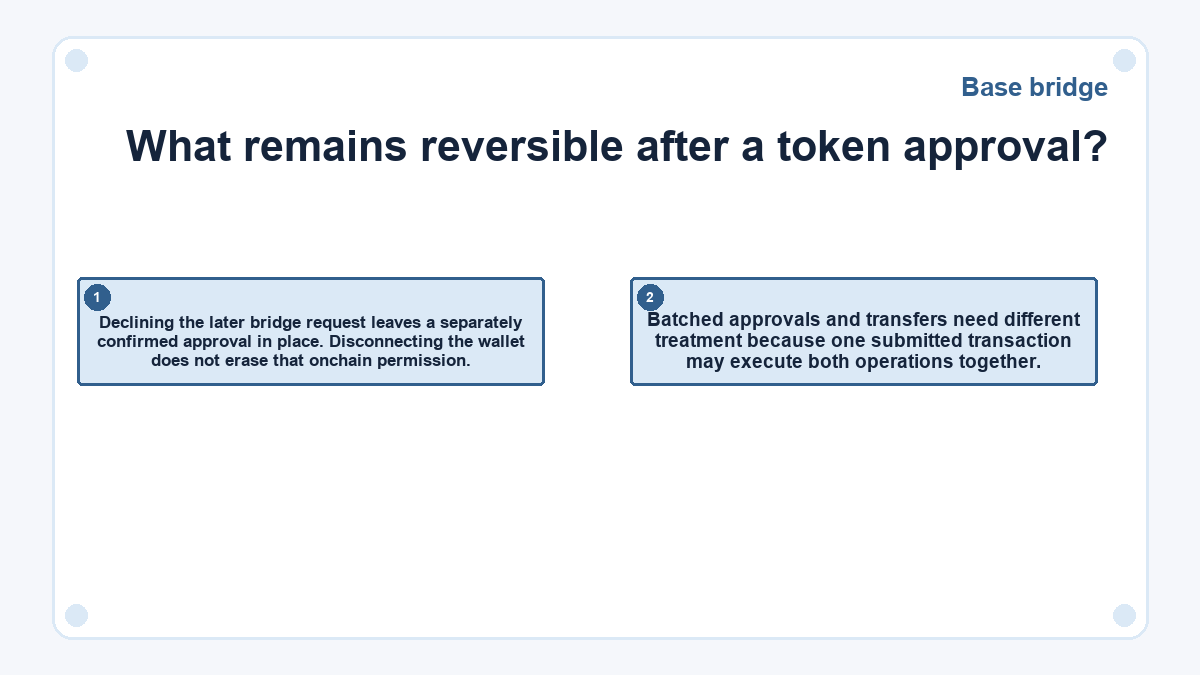
Declining the later bridge request leaves a separately confirmed approval in place. Disconnecting the wallet does not erase that onchain permission. Batched approvals and transfers need different treatment because one submitted transaction may execute both operations together.
Delivery estimates depend on the settlement method
A route promising earlier delivery may rely on destination liquidity, while a standard withdrawal depends on proof and finalization conditions.
A standard withdrawal from Base to Ethereum requires an Ethereum finalization transaction before the withdrawal completes. Proof acceptance and the applicable waiting conditions precede that action. A source confirmation therefore does not mean the recipient can already use the destination funds.
Liquidity providers can supply destination assets before the underlying standard settlement finishes. Their ability to do so depends on the route, asset, available liquidity, and accepted terms. Compare the event each estimate describes: destination delivery, eligibility to finalize, or final settlement. Those events answer different timing questions.
A changed quote can justify stopping after approval
Consider an ERC-20 transfer into Base where a separate approval has confirmed, but the bridge transaction remains unsigned. Should you continue or stop if the refreshed request differs? Both choices concern the same source balance, destination token, and recipient. Continuing accepts the refreshed transfer terms; stopping leaves this transfer unsubmitted, but the approved spender retains permission to spend within the allowance.
- Continue only if the refreshed route still accepts the source token and delivers the intended token on Base.
- Accept the output only if its amount and any swap minimum meet the transfer’s intended use.
- Confirm that the source account can cover the refreshed transaction cost.
- Reconsider authorization if the refreshed request names a different spender or recipient.
- If the route no longer fits, decline the unsigned transfer and address any unused allowance.
With compatible terms, submission creates the transfer record to follow through destination delivery. If compatibility or acceptable output disappears, declining leaves this transfer unsubmitted. The approval transaction remains as evidence of the permission granted. This choice changes if the bridge transaction has already executed: abandoning the quote or revoking permission cannot retrieve funds it already moved.
Submission limits changes to the recorded request
A successfully executed bridge transaction commits its encoded instructions, so changing a form afterward cannot replace the recipient or destination recorded onchain.
A pending transaction occupies a narrower window. On Ethereum and other EVM networks, some wallets support replacement using the same account nonce, subject to network acceptance and sufficient fees. The original transaction may confirm first. Treat a cancellation request as an attempted replacement until the chain confirms which transaction executed. After confirmation, any supported refund or recovery follows the bridge’s rules rather than the wallet’s pending-transaction controls.
Recovery depends on which operation failed
A failed source transaction, an unsuccessful destination relay, and an unfilled liquidity request represent different states with different recovery possibilities.
A reverted source bridge call does not commit the changes within that call, although execution consumes gas. An earlier approval can remain valid. If the source transaction succeeds but destination funds have not arrived, check the status of the corresponding bridge request or cross-domain message. A second deposit creates another request rather than repairing the first.
For standard messaging, the cross-domain messenger records successful and failed relays and supports replay under its rules. That does not make every underlying portal call replayable. The contract layer, original message, and recorded failure determine whether retrying execution is available. Resolve those details before treating a new transaction as recovery.
Some liquidity routes provide refunds for qualifying unfilled requests after a deadline. Expiry and refund receipt are separate events; settlement can occur later. Before committing, inspect whether the route provides that mechanism and which network, asset, and address receive the refund. A generic failure label does not establish refund eligibility.
Declining one route leaves other transfer models to compare
The former Base-hosted bridge interface was deprecated, so familiarity with an old screen does not establish an executable transfer path today. Supported interfaces and underlying contracts are separate considerations.
For compatible Ethereum assets, a standard bridge path provides the corresponding cross-domain transfer. A liquidity route offers different delivery and settlement dependencies. Funds already held with an exchange may qualify for a direct Base withdrawal when that asset and network are enabled. Compare these alternatives before submitting. After submission, continue from the original transfer’s recorded state rather than treating another route as its replacement.
Questions people ask about Base bridge
-
Does a gasless signature grant permission to spend tokens?
- A gasless signature can authorize token spending when it signs a permit the token supports. ERC-2612 permits include a spender, value, nonce, and deadline. Someone can submit a valid permit onchain later. Inspect the signature request before accepting it; the absence of an immediate gas charge does not make it a harmless wallet connection.
-
Will dividing a transfer bypass a route limit?
- Dividing a transfer does not establish that the route will accept every smaller request. Available liquidity and route conditions can change between submissions. Each request also has separate execution costs and tracking records. A limit applying to one quote should not be interpreted as permission to move the combined amount through repeated transactions.
-
Are two bridge interfaces necessarily using different contracts?
- Two bridge interfaces can submit transactions to the same underlying contracts. Different branding therefore does not establish a different settlement mechanism or recovery path. Compare the transaction target, token spender, and route details. An interface may also add a swap or service charge, so shared infrastructure does not make every displayed offer equivalent.
-
Which token behaviors can rule out the standard bridge?
- The standard bridge does not support fee-on-transfer or rebasing tokens because their behavior can cause accounting errors. A transfer fee changes the amount received, while rebasing changes balances independently of ordinary transfers. An ERC-20 label alone does not establish compatibility. The token pair must satisfy the bridge’s accounting and representation requirements.
-
Can another account finalize a standard withdrawal and take the funds?
- Another account can submit a valid finalization without gaining the right to replace the withdrawal recipient. Finalization uses the previously committed withdrawal data. Paying for that transaction does not redirect its output to the payer. This permissionless finalization applies to the standard withdrawal mechanism, not every service offering transfers involving Base.
-
Where would a refund go if the recipient differs from the sender?
- The route’s refund configuration determines the refund destination, which may differ from the delivery recipient. Some systems specify a separate refund address and network. Inspect those settings before submission, especially when sending to another account. A failed delivery does not by itself establish that the refund will return to the sending wallet.
-
Is increasing slippage tolerance a way to fix an unavailable bridge?
- Increasing slippage tolerance changes the acceptable execution range for a swap within a route. It does not enable an unsupported token, repair a paused bridge, or guarantee destination liquidity. A wider tolerance permits a worse swap outcome. Identify whether the failure concerns the swap price or the bridge operation before changing that setting.